Changed Minds Change Lives

Changed Minds Change LivesChanged Minds Change LivesChanged Minds Change Lives
Home
Treatment Ethos
Assessments
FAQ
Specialties
Scientific Work
My Inspiration
Books
  • The PPI Companion
  • PPI Workbook
  • E&P Curriculum
  • The Theory of Existence

Changed Minds Change Lives

Changed Minds Change LivesChanged Minds Change LivesChanged Minds Change Lives
Home
Treatment Ethos
Assessments
FAQ
Specialties
Scientific Work
My Inspiration
Books
  • The PPI Companion
  • PPI Workbook
  • E&P Curriculum
  • The Theory of Existence
More
  • Home
  • Treatment Ethos
  • Assessments
  • FAQ
  • Specialties
  • Scientific Work
  • My Inspiration
  • Books
    • The PPI Companion
    • PPI Workbook
    • E&P Curriculum
    • The Theory of Existence
  • Home
  • Treatment Ethos
  • Assessments
  • FAQ
  • Specialties
  • Scientific Work
  • My Inspiration
  • Books
    • The PPI Companion
    • PPI Workbook
    • E&P Curriculum
    • The Theory of Existence

My Former Academic Work

One of the biggest reasons I decided to leave academia and transition into clinical work in December of 2024 was my research program. You will see below what I was building in academia, and also how I am still building it, but now where it matters the most, with the one-on-one connections to those people. 


The Experience Integration Framework

The daily reality for people who use substances: they walk into clinics burdened by the fear that saying the wrong thing could impact their care, they share their struggles only to be dismissed, misunderstood, or even ridiculed, and they face a cycle of stigma and diminishing resources that alienates them from friends, family, and even from themselves. They encounter judgment instead of understanding, barriers instead of support, and punishment instead of treatment. These obstacles aren’t merely physical—they permeate everything—embedded in language, facial expressions, policies, and cultural attitudes.

See My Academic CV

Let's Give It a Name

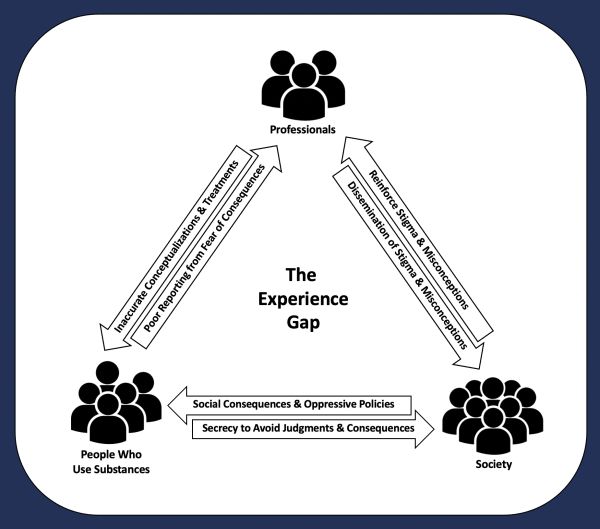
Imagine a triangle of disconnect between three groups: 1) individuals who use substances, 2) the professionals who work with them, and 3) society at large. 


For individuals using substances, these gaps leads to feelings of judgment and isolation, while professionals, constrained by outdated or incomplete models, may miss the deeper motivations behind substance use. Society, meanwhile, reinforces stigma through stereotypes and policies not only hinder recovery, but it actively pushes people into worse conditions that make substance use worse. 
Now, imagine a world where these gaps close—a world where we see the person, not just the substance use or condition. In this world, treatment isn’t a rigid, one-size-fits-all process; it’s personalized, grounded in compassion, and driven by the individual’s own strengths and hopes. It’s a world where friends and family foster recovery, possibility, growth, and empowerment. It's a world where people end up with knowledgeable, compassionate professionals instead of prison.

It Doesn’t Have To Be Imaginary

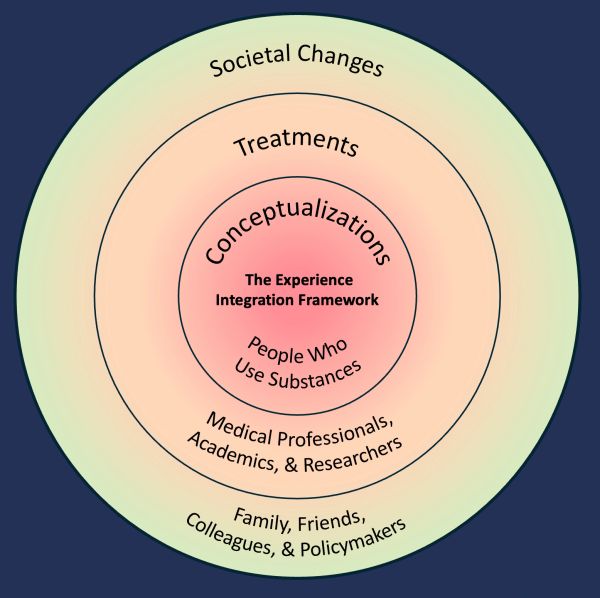
Let's organize the chaos into a framework.


At the center of it all are the people who use substances; but, maybe we know less than we think about why people use substances.


In the next level, we have professionals who study and treat these individuals; but, maybe we know less than we think about how to care for people who use substance use.


Above it all, we have society who set up and reinforce systems consisting of resources and responses; but, maybe we know less than we think about why these systems often make substance use worse.

Notice how the colors blend into each other, reflecting the reality that each layer is interconnected, flowing, and constantly influencing the others.


Now, notice how the layers are embedded, reflecting that to truly help people who use substances, we cannot focus exclusively on any one of them.


Any progress at one level is likely be undermined if we ignore the higher layers. Thus, it seems that to sustain progress, we need to address all the layers.

So How Do We Do This?

Let's unfold these layers into a plan, phases, each building on the last.


Phase I: We must go back to the people and hear what they have to say. 


Phase II: We must take this knowledge to develop better strategies to tackle their problems.


Phase III: We must use this knowledge and these strategies to change systems of oppression into systems of growth.


So good so far? Let's break this plan down.

Phase I: Close the Gap - People & Professionals

Here is where we are at right now. We must build stronger frameworks that incorporate people's opinions and perspectives to improve our understanding of why people use substances despite the consequences. 


Here are some of my Phase I papers.

Substance Use Serves a Very Important Function

I introduce a concept called Substance-Induced Emotion Regulation, which suggests that people use substances to change their emotional states to help them do something better (e.g., drinking to be more sociable)

See More

People Really Enjoy Using Substances

I developed the Enthusiastic Substance Use Attitudes Scale (ESUAS) to capture positive views on substance use benefits, like socializing and relaxation, for a more understanding and less stigmatizing perspective.

See More

People Accurately Know The Addiction Risk

People Accurately Know The Addiction Risk

I introduce a concept called perceived addiction potential, which is how likely someone thinks they are to develop an addiction. I showed that people’s self-assessed risk aligns with their actual risk factors, challenging the assumption that people underestimate their SUD risk.

See More

Phase II: Close the Gap - Professionals & Society

Then, we must shape the public's perception of why people use substances by demonstrating potentially effective treatments that use atypical strategies. 


Here are some of my Phase II papers.

We Can Focus on Treatment Strategies Beyond Abstinence

I demonstrated that there may be alternative approach to treating cannabis use disorder that do not involve abstinence, such as reducing cravings and use. I also demonstrate that men benefit more from craving reduction and women respond better when addressing depression.

See More

We Can Focus On The Growth Potential Despite Use

I argued that substance use treatments should incorporate positive psychology, which focuses on enhancing life satisfaction, to address addiction more effectively.

See More

Substances Use May Lead to Short-Term Well-Being

Substances Use May Lead to Short-Term Well-Being

I introduced a new perspective using positive psychology to understand why people turn to substances, suggesting that they may help people fulfill basic needs for happiness, like joy, engagement, and connection.

See More

Phase III: Close the Gap - Society & People

Finally, we must use all this knowledge and treatment demonstrated in conjunction with people, to support widespread system changes.


Here are some of my Phase III papers.

Removing Stigmatizing Language Reduces Stigma WIthout Affecting Measurement Accuracy

I found that removing stigmatizing language from self-report measures (like at the doctor's office) didn’t change the tool’s accuracy but did lower participants' stigmatizing beliefs, especially among those without a history of substance use. 

See More

The War On Drugs Has Negatively Affected Research

I argued that the War on Drugs has biased substance use research to overemphasize harm and ignore potential benefits of substances. I call on researchers to approach research with less bias - exploring risks and benefits.

See More

Did You Hear About the Cannabis Contriversey in Ohio?

Did You Hear About the Cannabis Contriversey in Ohio?

I analyzed Ohio's cannabis legalization struggle and present five strategies I think lead to successful policy change, which were ongoing advocacy, strong coalitions, empowering grassroots movements, data-driven research, and public education.

See More

You Can Do It Too

We all contribute to these gaps unintentionally, but being aware of them is the first step. I use this awareness in my clinical practices to overcome these barriers caused by these gaps... to treat the illness not the person, to reduce the harmful effects of stigma and shame, and to ultimately target the problems causing such behaviors, not the behaviors themselves,

Curriculum Vitae

Download My CV

Copyright Bryant Stone © 2025 - All Rights Reserved

This website does not track user analytics.